
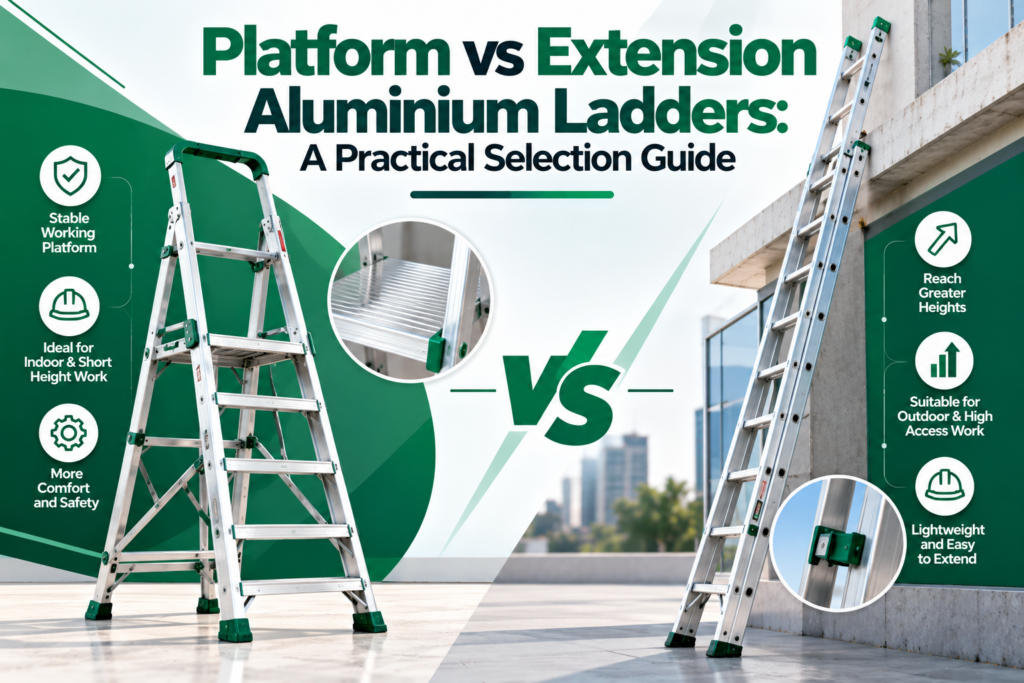
How Do You Choose the Right Aluminium Ladder?
The right aluminium ladder depends on the task, required reach, work duration, available space and conditions at the worksite. Platform ladders and extension ladders serve different purposes, so selecting one based only on height or price may result in unsuitable equipment.
A platform ladder may suit tasks that benefit from a defined standing platform, while an extension ladder may be appropriate for certain access tasks where the ladder can be positioned and secured correctly. Neither type is suitable for every job, and both must be used according to their product instructions and the site’s safety requirements.
For contractors, maintenance teams and businesses in Saudi Arabia, it is important to assess the task first, then compare ladder types, dimensions, load ratings and construction quality.
What Are Aluminium Ladders Used For?
Aluminium ladders provide access for suitable work at elevated positions. Depending on their design, they may be used for selected inspection, maintenance, installation, stock-access and building-repair tasks.
Common types include:
- Step ladders: self-supporting ladders designed for use in their approved open configuration.
- Platform ladders: ladders with a designated standing platform and specific protective features depending on the model.
- Extension ladders: adjustable-length ladders designed to reach selected elevated access points.
- Combination ladders: products that can be configured in different approved ways according to the manufacturer’s instructions.
The product name alone does not establish its permitted use. Check the exact model’s specifications, load rating and instructions before purchase.
Platform Ladder vs Extension Ladder
Understanding the differences helps narrow down the options.
Consideration | Platform ladder | Extension ladder |
Typical design | Self-supporting ladder with a designated platform | Adjustable-length ladder that leans against a suitable support |
Main purpose | Suitable tasks that benefit from a standing platform | Suitable access tasks requiring greater reach |
Placement | Requires a stable, level base and correct setup | Requires correct angle, stable footing and suitable upper support |
Storage | Depends on the platform size and folding design | Length and storage requirements vary |
Movement | Often convenient for repeated low-level tasks, depending on model | Must be lowered and repositioned as needed |
Key checks | Platform, locks, feet and protective features | Rungs, locks, rails, feet and positioning requirements |
These are general distinctions. The manufacturer’s instructions determine the correct setup and permitted use of the particular ladder.
When Should You Consider a Platform Ladder?
A platform ladder may be appropriate when a task benefits from a designated standing surface and the work can be completed within the ladder’s approved use conditions.
Potential applications include suitable maintenance, inspection, stock-access and installation tasks. The platform’s dimensions, guardrails, steps and load rating should match the work.
Before buying, consider:
- Task duration: A ladder may not be the best choice for prolonged work requiring extensive movement.
- Working position: The user should not need to stretch or lean beyond a safe position.
- Required height: Confirm the platform height and permitted reach instead of estimating from the ladder’s overall length.
- Floor conditions: The base must stand securely on a suitable surface.
- Tools and materials: Follow the product’s load limit and keep access clear.
- Nearby hazards: Consider doors, pedestrians, overhead electrical lines and other site risks.
If the task requires frequent movement across a large area, a suitable scaffold platform or other access system may be more appropriate.
When Should You Consider an Extension Ladder?
An extension ladder can be useful for certain access tasks where its design and placement are appropriate. It must be positioned at the required angle, supported by suitable surfaces and secured according to the manufacturer’s instructions and applicable site procedures.
Before choosing an extension ladder, verify the maximum permitted length, overlap requirements for extending sections, locking mechanisms, load rating and storage dimensions. Never use an improvised extension or combine ladders unless the manufacturer expressly approves that configuration.
An extension ladder should not be selected simply because it can reach a particular height. Consider whether the task can be performed safely from a ladder and whether another access method would provide a more suitable working position.
How to Select the Correct Ladder Height
Ladder height and working reach are different measurements. The correct selection depends on the ladder design, the user’s position and the task.
Follow these steps:
Step 1: Measure the work location
Identify the point that needs to be reached and the position where the ladder can safely stand.
Step 2: Identify the ladder type
A platform ladder and an extension ladder have different setup requirements. Determine which type is appropriate before comparing heights.
Step 3: Review the manufacturer’s measurements
Check the ladder’s overall length, platform height or permitted setup range. Do not estimate safe reach using a generic formula.
Step 4: Assess the access route
Ensure the ladder can be transported to the work area and placed without blocking emergency routes or creating other hazards.
Step 5: Confirm the load rating
The permitted load must account for the user and anything carried or placed on the ladder as defined by its instructions. Never exceed the rating.
Aluminium Ladder Safety Checklist
Ladder safety begins with selecting the correct product and checking it before use.
- Inspect the rails, rungs, feet, locks, hinges and platform for damage.
- Use the ladder only in the configuration approved by the manufacturer.
- Position it on a firm, level and stable surface.
- Keep the ladder away from electrical hazards; aluminium is conductive.
- Maintain safe contact while climbing and avoid carrying items in a way that compromises balance.
- Do not stand on rungs or sections that the manufacturer prohibits.
- Avoid overreaching; climb down and reposition the ladder when necessary.
- Keep doorways, walkways and the surrounding area controlled.
- Do not use a damaged ladder or make unapproved repairs.
- Follow the project’s risk assessment, training requirements and applicable safety rules.
For work near electrical equipment or overhead power lines, a suitable non-conductive ladder may be required. Aluminium ladders should not be treated as electrically insulating.
Saudi Arabia’s official workplace safety resources include guidance on construction-site hazards and safe work practices. Consult the relevant guidance and the requirements applicable to your project.
Aluminium Ladders for Construction and Industrial Businesses
Different businesses may need different ladder types. A maintenance contractor might need a compact platform ladder, while a warehouse may require a ladder designed for a particular access task. Industrial work can involve additional hazards, so the product must match the operating environment.
Before purchasing ladders for a team, consider whether several ladder types are needed. Standardising equipment may simplify inspection and storage, but only when each model suits its intended task.
Keep an inventory showing the ladder type, model, identification details, inspection status and storage location. Remove damaged equipment from service and follow the manufacturer’s guidance on inspection and replacement.
How to Buy Aluminium Ladders in Saudi Arabia
When requesting a quotation, share the ladder type, required height or reach, intended application, permitted load requirements and quantity. Explain any access restrictions, storage requirements or special site conditions.
Ask the supplier to confirm:
- Exact model and ladder type.
- Dimensions and setup requirements.
- Load rating and intended use.
- Materials and relevant product documentation.
- Inspection and maintenance instructions.
- Delivery arrangements and commercial terms.
On Scaffolding Suppliers Saudi Arabia, aluminium ladders are offered for sale only. Rental arrangements should not be assumed. You can start at the product categories page and contact the team to confirm which models and quantities are available.
Frequently Asked Questions
Which aluminium ladder is better: platform or extension?
It depends on the task. A platform ladder may suit appropriate work from a standing platform, while an extension ladder may suit certain access tasks at greater reach. Choose based on the product instructions and site risk assessment.
Are aluminium ladders suitable for electrical work?
Aluminium conducts electricity. Where electrical hazards exist, select equipment and controls appropriate to the task; a suitable non-conductive ladder may be required.
How do I choose the correct ladder height?
Measure the work location and review the ladder’s actual dimensions and permitted setup. Do not rely on the ladder’s overall length as a direct measure of safe working reach.
Can a ladder replace scaffolding?
Not always. Scaffolding may be more appropriate when a larger work platform, repeated movement or a different access arrangement is required. Choose the system based on the task.
What should I check before buying an aluminium ladder?
Check the ladder type, dimensions, load rating, locks, feet, rails, platform and manufacturer instructions. Ensure the ladder is suitable for the intended work environment.
Conclusion
Platform and extension aluminium ladders serve different purposes. A platform ladder may suit tasks that benefit from a designated standing surface, while an extension ladder may work for appropriate access tasks when correctly positioned and secured. The safest choice depends on the task, reach, surface, hazards and product instructions.
For aluminium ladders in Saudi Arabia, prepare your requirements before requesting a quote. Visit Scaffolding Suppliers Saudi Arabia to enquire about available products and confirm specifications, quantities and delivery arrangements.